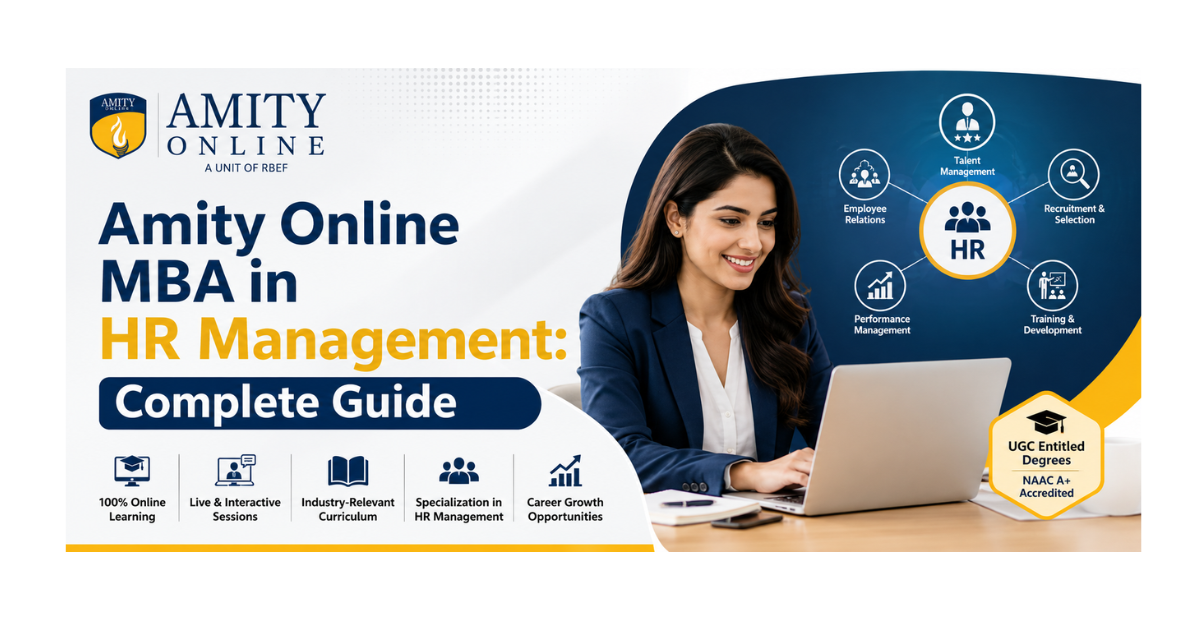
Amity Online MBA in HR Management: Complete Guide
Table of Contents
- What the Amity Online MBA in HR Management Actually Covers
- Who This Program Is Really Built For
- The Case for an HR Specialization Right Now
- Working Professional vs Fresh Graduate: Different Reasons to Enroll
- Eligibility and How the Admission Process Actually Works
- Basic Eligibility Requirements
- Documents and Steps in the Admission Process
- Course Duration, Structure, and What You'll Study
- Year One vs Year Two: How the Workload Shifts
- Core Management Subjects
- HR-Focused Electives
- Understanding the Fee Structure
- How the Learning Actually Happens
- Live Classes, Recordings, and the LMS
- Assignments, Exams, and Where Students Usually Struggle
- What This Degree Can Actually Do for Your Career
- Realistic Job Roles After Completion
- Salary Expectations, Honestly
- Why UGC Recognition and Accreditation Matter More Than People Realize
- Amity Online MBA HR vs a Traditional Campus MBA
- How to Actually Get Value Out of an Online MBA
- Common Mistakes Candidates Make Before and During the Program
- Conclusion
Over the last couple of years, I have observed something. The human resources department has ceased being the butt of jokes: it has moved on from only receiving filing paperwork and bringing in cakes to the workplace. It's turned into a seat at the table, and companies are actually promoting people into HR leadership based on whether they understand budgets and workforce strategy, not just policy manuals. That's part of why the Amity Online MBA in HR Management keeps coming up when people search for a way to formalize HR skills without quitting their job.
Before getting into the details of the program, let me say that it is a lengthy one, so grab a cup of coffee. I will try to explain what the program includes, who will benefit from it, and where students fail in their assessment of the program itself. Before we start, let me tell you that the information regarding the admission fees and requirements changes every year, so use the information given here only as a learning point. Check the official Amity page before you make a decision based on a number you read online, including this one.
What the Amity Online MBA in HR Management Actually Covers
At its core this is a two-year MBA run through Amity University Online, and the HR specialization gets layered in mostly during the second year. You'll still sit through the usual MBA subjects everyone deals with regardless of what they specialize in: finance, marketing, operations, economics. Where it gets interesting is the electives, which pull you into recruitment strategy, labor law, compensation planning, and how organizations actually behave once you strip away the theory.
Here's a way to think about it that I find useful. A general MBA teaches you how a business functions. The HR track includes teaching how to find talent and employ them, evaluate them, and pay them and sometimes even fire them.
Who This Program Is Really Built For
The Case for an HR Specialization Right Now
Attrition is expensive. Bad onboarding is expensive. A compensation structure that's out of line with the market quietly pushes your best people toward the door before you even notice they're job hunting. Companies have caught on to this, which is why HR has stopped being treated as an admin function in a lot of workplaces and started being treated as something closer to a business strategy function.
That's really the practical reason an MBA with an HR focus carries more weight now than it did ten years ago. It tells an employer you can speak both languages, HR and business, in the same meeting.
Working Professional vs Fresh Graduate: Different Reasons to Enroll
People engaged in HR take this program to advance their title to a more supervisory one or to support their professional experience with theoretical knowledge. Recent graduates often choose this program for a different reason altogether—to enter the field of HR from a different profession background or to establish some foundational knowledge prior to looking for an entry level position.
If you're already in HR, my honest suggestion is to treat every single module as a chance to check theory against what you're seeing at your own desk. That's genuinely where most of the learning happens, not in the textbook.
Eligibility and How the Admission Process Actually Works
Basic Eligibility Requirements
Generally speaking, programs like this one expect:
- A bachelor's degree from a recognized university, usually under the 10+2+3 structure
- A minimum aggregate percentage, often somewhere around 45 to 50 percent, though this shifts
- Work experience, which helps but isn't always a strict requirement
None of these figures are fixed in stone. Universities revise admission criteria fairly often, so don't rule yourself in or out based on a number from an old blog post. Confirm it directly.
Documents and Steps in the Admission Process
The process is mostly online and doesn't involve running around with physical files:
- Fill out the application with your academic and personal details
- Upload your degree certificate, mark sheets, and ID proof
- Pay the registration fee
- Wait for document verification
- Pay the semester fee once you're approved
- Get your login for the learning management system
It usually moves fast once your paperwork checks out, though verification can slow down during busy admission windows.
Course Duration, Structure, and What You'll Study
Two years, four semesters, that's the standard shape of it. And most online MBA providers, Amity included, give you room to stretch the timeline if life or work gets in the way. That flexibility is honestly one of the better reasons to pick the online route in the first place.
Year One vs Year Two: How the Workload Shifts
Year one is foundational. Every MBA student, regardless of specialization, ends up covering roughly the same ground here. Year two is where things actually narrow down and start feeling like an HR degree rather than a general management one, usually wrapping up with a project tied to a real workplace problem.
Core Management Subjects
- Principles of Management
- Business Communication
- Financial Accounting
- Marketing Management
- Organizational Behavior
- Business Economics
HR-Focused Electives
- Talent Acquisition and Recruitment Strategy
- Compensation and Benefits Management
- Labor Laws and Industrial Relations
- Performance Management Systems
- Learning and Development
- Strategic Human Resource Management
By the time you're done, sitting through a compensation review or a labor dispute conversation should feel a lot less like foreign territory.
Understanding the Fee Structure
I'm not going to throw a specific fee figure at you here, because it would likely be outdated the moment this gets published, and frankly a lot of articles online are already quoting numbers from two admission cycles ago. What tends to hold true is that online MBA fees run lower than a full-time campus MBA, and most universities let you pay semester-wise instead of all at once. For the actual current number, go to Amity's official site or call their admissions counselors directly. Don't trust a third-party figure blindly, mine included.
How the Learning Actually Happens
Live Classes, Recordings, and the LMS
You get a mix of live sessions and recorded lectures through an online portal. If work eats into a live class, and it will at some point, the recording is sitting there waiting so you don't fall behind on the module.
Assignments, Exams, and Where Students Usually Struggle
There are regular assignments, case-based evaluations, and online proctored exams at set intervals. What trips people up usually isn't the difficulty of the subject matter. It's time. Fitting an MBA schedule around a full-time job, especially during a rough week at work, is the real test of this program, more than any single subject on the syllabus.
What This Degree Can Actually Do for Your Career
Realistic Job Roles After Completion
Graduates tend to move toward roles like:
- HR Manager
- Talent Acquisition Manager
- Learning and Development Specialist
- Compensation and Benefits Analyst
- HR Business Partner
- Employee Relations Manager
If you're already working in HR, this degree often becomes the piece of paper that finally lets you claim a title you were already doing the work for.
Salary Expectations, Honestly
I will be honest. Salary can vary so much according to the industry, location as well as one’s prior experience that providing you with a clean figure is simply impossible. In fact, anyone who offers you an exact number is guessing. What does tend to hold true is that the jump becomes noticeable once you're past the three to five year experience mark and applying for HR Business Partner or managerial roles, where a formal degree paired with real experience actually moves the needle in a negotiation.
Why UGC Recognition and Accreditation Matter More Than People Realize
People usually ignore this section although, honestly speaking, it is the one that matters. A degree obtained through the UGC method has exactly the same value as an ordinary degree, as far as getting a job and pursuing further education in India is concerned. Amity University is a NAAC accredited institution that offers UGC programs and that is why so many professionals trust this institution. That said, accreditation status gets reviewed and renewed on a schedule, so check it for your specific admission year rather than taking a brochure's word for it. Go look at the UGC's own list of entitled institutions yourself before you enroll.
Amity Online MBA HR vs a Traditional Campus MBA
| Factor | Online MBA HR | Traditional Campus MBA HR |
|---|---|---|
| Flexibility | Fits around your job | Fixed classroom schedule |
| Cost | Generally lower | Generally higher |
| Networking | Mostly digital | Strong in-person networking and placement cells |
| Timeline | Often extendable | Fixed academic calendar |
| Best suited for | Working professionals protecting income | Fresh graduates with time to spare |
Neither one wins outright. It really comes down to what matters more to you right now: keeping your paycheck and work experience going, or getting the deeper in-person network a campus MBA offers.
How to Actually Get Value Out of an Online MBA
Block out real study hours on your calendar instead of hoping free time shows up on its own, because it rarely does. Show up for live sessions rather than defaulting to recordings every time, the discussion between students often teaches you more than the lecture slides do. Try applying what you're learning to your actual job the same week you learn it. If the module covers compensation design, go look at how your own company structures its pay bands and see if the theory holds up.
Talk to your classmates too. Some of the strongest HR networking I've come across happened inside these online cohorts, not after graduation at some alumni event. And don't write off labor law or compensation as boring filler electives. In real HR jobs, those come up far more often than the flashier strategy subjects everyone gets excited about.
Common Mistakes Candidates Make Before and During the Program
There are certain trends that repeat themselves endlessly. Individuals have a tendency to trust outdated eligibility requirements or fee structures found on the web. They do not fully grasp the actual time commitment required by the program and apply to it without knowing how long one can realistically finish it. They also see the degree as a formality instead of a tool, which becomes evident when they cannot elaborate on what they have learned during the interview. And a fair number skip the accreditation check entirely just because a friend already has the same degree, without confirming that the entitlement status still applies to their own admission year.
Conclusion
The Amity Online MBA in HR Management won't hand you a promotion on its own, and it's not some shortcut either. What it actually gives you is a structured, legally grounded understanding of HR that most people working in the field never sit down and formalize. Whether it's worth your time comes down to how much effort you put into the live sessions, the case studies, and the slightly tedious but genuinely useful habit of connecting what you're studying to what's actually happening at your job. Do that consistently and the degree earns its spot on your resume instead of just sitting there as a line item.