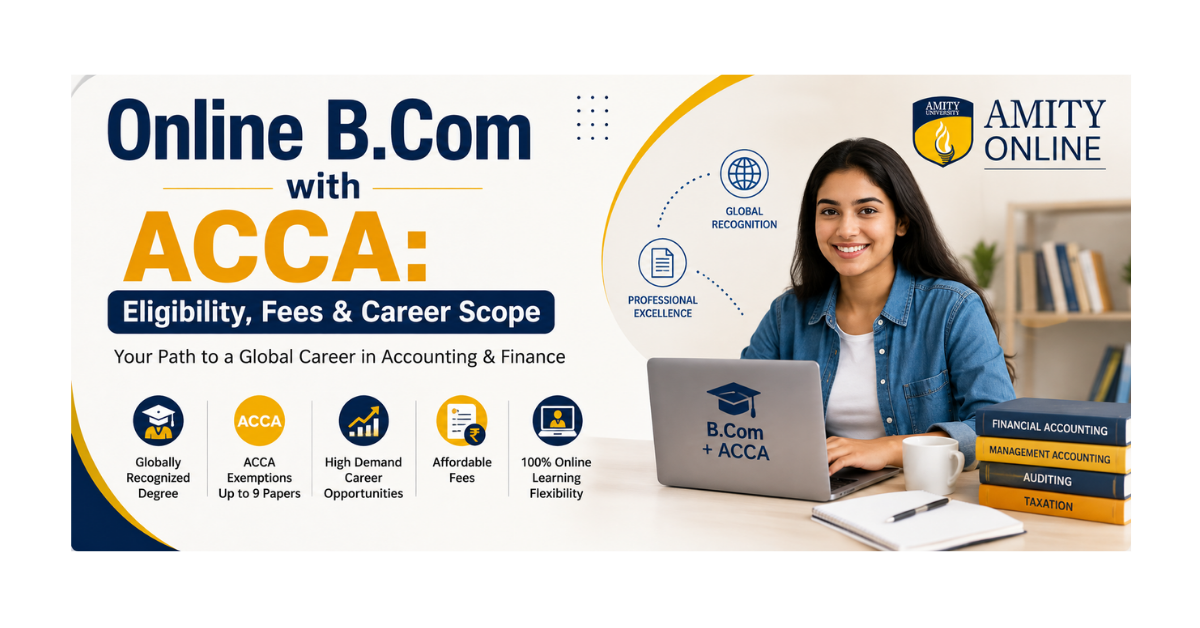
Online B.Com with ACCA: Eligibility, Fees & Career Scope
Table of Contents
- What Exactly Is an Online B.Com with ACCA?
- How the Two Qualifications Work Together
- Why Bother Combining B.Com with ACCA?
- What You Actually Gain From This Combo
- Studying Online B.Com with ACCA Through Amity Online
- The Exemption Angle Everyone Talks About
- The Free One-Year Zell Education Access
- What This Support Actually Covers
- The Real Benefits of Doing B.Com Alongside ACCA
- A Degree and a Professional Badge, Together
- Business Sense You Can Use Anywhere
- ACCA's Passport Value Across Borders
- Studying On Your Own Clock
- Who Can Actually Apply?
- The Basic Boxes You Need to Tick
- What Will This Actually Cost You?
- Where Can This Combination Take Your Career?
- Job Roles Worth Knowing About
- What Nobody Really Tells You Before You Enrol
- Is This Path Right for You?
- Before You Sign Up, Check These Things
- Nail Down Your Exemptions First
- Online B.Com with ACCA vs the Traditional Route
- Final Thoughts
What Exactly Is an Online B.Com with ACCA?
An online Bachelor of Commerce degree from a prestigious institution is often pursued by students along with ACCA preparation and completion (ACCA, The Association of Chartered Certified Accountants). The B.Com course is standardized across various colleges/universities and includes subjects including, but not limited to, Financial Accounting, Business Law, Foundations of Taxation, Economics, and Management. The ACCA qualification adds to the B.Com course, resulting in a specialized qualification in accounting and finance.
The reason universities pair the two isn't just marketing. A commerce degree on its own gives you breadth. ACCA gives you depth in one direction, professional accounting practice, financial reporting, and audit standards that employers actually test for in interviews.
How the Two Qualifications Work Together
Picture your B.Com as the base layer and ACCA as specialised training built on top of it. You're not learning two unrelated subjects. Many B.Com topics, like financial accounting or cost accounting, overlap directly with early ACCA papers. That overlap is exactly why exemptions exist, which we'll get into shortly.
Why Bother Combining B.Com with ACCA?
Here's the practical reasoning, not the brochure version. A standalone B.Com typically runs three years. ACCA can also be pursued along with the B.Com course, even if the individual has never taken the course and does not have prior knowledge of commerce. Completing them together saves time because it allows the student to take credit for their academic efforts towards both the degrees.
What You Actually Gain From This Combo
By the time you finish both, you should have:
- A working understanding of financial accounting and reporting
- Practical exposure to auditing concepts, not just theory
- Taxation knowledge relevant to real filing and compliance work
- A business and management perspective that goes beyond ledgers
- Analytical skills you can use to actually read a company's financial health
- A professional qualification with recognition outside India, not just a local degree
Studying Online B.Com with ACCA Through Amity Online
Amity Online is one of the universities offering this pairing, letting students complete their B.Com online while preparing for ACCA papers with support from an affiliated education partner. If you sit through an admissions counselling session for this programme, one topic comes up almost every time: exemptions.
The Exemption Angle Everyone Talks About
ACCA's full qualification has 13 papers. That number alone puts off a lot of prospective students. However, there is a possibility that ACCA may exempt you from some papers if your previous academic experience also covers related studies. For candidates with prior commerce education such as a B.Com degree, exemption may extend from 9 to 13 papers. This means they may have to only pass 4 papers to complete the course.
Is That 9-Paper Exemption a Sure Thing?
No, and this is worth being blunt about. Exemptions are not automatic and not identical for every student. They depend on:
- Your specific prior qualification
- The exact subjects and syllabus depth you studied
- ACCA's exemption policy at the time you apply, which does get updated periodically
- ACCA's own review of your transcripts against its current mapping
Do not take “up to 9 out of 13” as a guaranteed number for applicants since it varies from candidate to candidate. For instance, consult your advisor about this figure and whether it is applicable to you.
The Free One-Year Zell Education Access
For the papers that remain after exemptions, Zell Education is commonly named as the tutoring partner attached to this kind of programme. Students are often offered a complimentary one-year subscription to Zell's ACCA preparation resources as part of the admission package.
What This Support Actually Covers
The Real Benefits of Doing B.Com Alongside ACCA
A Degree and a Professional Badge, Together
You're not picking between an academic degree and a professional credential. You work toward both in parallel. The B.Com anchors your understanding of commerce as a discipline. ACCA adds the specialised, internationally benchmarked accounting skill set that recruiters specifically screen for in finance roles.
Business Sense You Can Use Anywhere
B.Com isn't only about balance sheets. The undergraduate program usually includes topics about economical acknowledgment, fund management, marketing practices and principles, organizational behavior, and economics. The broad context is essential because it makes professional knowledge obtained in the field of accounting less difficult to understand. You understand why a business makes certain financial choices, not just how to record them.
ACCA's Passport Value Across Borders
The ACCA qualification is recognized not just in India. This is important in case you plan to work abroad one day. Nevertheless, having a ACCA qualification does not mean you are automatically entitled to work in all countries. Local laws regarding accounting practices and licensing regulations need to be observed.
Studying On Your Own Clock
This is the benefit most students actually feel day to day. It is easier to study an undergraduate degree if you choose the online course format. This format gives you an opportunity to study at any time of the day, be it either early in the morning or late at night. If you are going to take ACCA exam in addition to your studies, this feature can make a difference.
Who Can Actually Apply?
The Basic Boxes You Need to Tick
This path tends to make sense for:
- Class 12 commerce students planning ahead
- Anyone genuinely interested in accounting as a profession
- Students who already know they want to work in finance
- People aiming for a globally recognised accounting credential
- Learners who want the option, even if not the certainty, of working abroad later
What Will This Actually Cost You?
This is where a lot of students get an unpleasant surprise later, so it's worth spelling out clearly. Your total spend isn't just the university's B.Com tuition. Budget separately for:
- B.Com programme fees charged by the university
- ACCA registration and related administrative charges
- ACCA examination fees, which apply per paper
- Study material or preparation costs beyond any complimentary subscription
- Any additional service charges tied to a tutoring partner
Both university fees and ACCA's own charges change periodically, sometimes annually. Don't plan your budget around a number someone quoted you last year. Ask for the current, written fee structure before you commit to anything.
Where Can This Combination Take Your Career?
Job Roles Worth Knowing About
With the degree completed and a reasonable number of ACCA papers cleared, realistic entry points include:
- Accountant
- Financial Analyst
- Audit Associate
- Tax Associate
- Accounts Executive
- Financial Reporting Associate
- Management Accountant
- Finance Executive
- Internal Audit Professional
- Business Finance Associate
Industries Hiring Finance and Accounting Talent
Demand for these skills isn't limited to banks and financial services firms, though those remain strong hirers. You'll also find openings in consulting, IT and technology companies, manufacturing, e-commerce, retail, healthcare, and professional services firms. Any organisation that manages money at scale needs people who can read a financial statement properly, and that's most organisations.
What Nobody Really Tells You Before You Enrol
A few practical realities worth knowing upfront. First, ACCA papers are genuinely difficult, and exemptions don't make the remaining papers easy by comparison; they still demand real study time. Second, balancing a full B.Com workload with ACCA preparation requires consistent weekly effort, not last-minute cramming, since ACCA exam sessions run on fixed windows through the year. Third, "complimentary" support like a tutoring subscription is a helpful head start, not a replacement for your own discipline. Degree programs combined with a professional qualification can be beneficial for well-organized students, and overwhelming for those who are struggling with self-paced studies. Therefore, it is important that the potential student be realistic about their study habits.
Is This Path Right for You?
Some questions all potential students should ask themselves directly: Do I want to work with financial information? Or does it sound good? Otherwise, it would be better to choose some other alternative program. If you want a recognised degree, a professional accounting credential, some international flexibility down the line, and the ability to study on your own schedule, it's a reasonable fit. If you're chasing it purely for the qualification's reputation without any real interest in the subject matter, the workload will likely feel like a grind rather than a fit.
Before You Sign Up, Check These Things
Don't let a well-rehearsed counselling pitch do your thinking for you. Before enrolling, verify directly with the university and, where relevant, with ACCA itself:
- Current B.Com eligibility requirements
- The latest programme fee, confirmed in writing, not a figure from an old brochure
- ACCA registration and examination charges as they stand today
- Your personal, confirmed ACCA exemptions, not a generic estimate
- The exact duration of any complimentary subscription, such as Zell Education access
- What that subscription specifically includes and excludes
- Current ACCA syllabus and exam structure, since these are periodically revised
- The university's degree recognition and accreditation status
Nail Down Your Exemptions First
If exemptions are a major reason you're drawn to this programme, don't leave that to chance or to a verbal estimate from an admissions call. Run your academic background through ACCA's official exemption assessment, or request written confirmation from the university's admissions team, before you build a study timeline around a number that might not actually apply to your transcript.
Online B.Com with ACCA vs the Traditional Route
| Feature | Online B.Com with ACCA | Traditional B.Com |
|---|---|---|
| Commerce degree | Yes | Yes |
| ACCA pathway | Built into the programme structure | Usually pursued separately, often later |
| Learning format | Online | Classroom-based |
| Professional accounting focus | Generally stronger | Depends heavily on the individual college |
| Flexibility | High | Lower |
| International career pathway | ACCA adds this option | Usually requires an additional qualification afterward |
Final Thoughts
An Online B.Com with ACCA is a genuinely practical way to sequence two useful qualifications instead of tackling them years apart. Your B.Com builds the commerce foundation; ACCA sharpens that into professional-grade accounting skill with recognition beyond India's borders. Another way to make the program less demanding is to look into possible paper exemptions. In this way, students will be able to lighten their load if they know where they can find exemptions.